YBX3
Gene Information
- Official Symbol: YBX3
- Official Name: Y-box binding protein 3
- Aliases and Previous Symbols: N/A
- Entrez ID: 8531
- UniProt: P16989
- Interactions: BioGRID
- PubMed articles: Open PubMed
- OMIM: Open OMIM
Function Summary
- Entrez Summary: N/A
- UniProt Summary: Binds to the GM-CSF promoter. Seems to act as a repressor. Binds also to full-length mRNA and to short RNA sequences containing the consensus site 5'-UCCAUCA-3'. May have a role in translation repression (By similarity). {ECO:0000250}.
Pfam Domains GO Terms
Pfam Domains
| CSD |
GO Terms
| negative regulation of intrinsic apoptotic signaling pathway in response to osmotic stress |
| polysome binding |
| regulation of intrinsic apoptotic signaling pathway in response to osmotic stress |
| regulation of cellular response to osmotic stress |
| positive regulation of cytoplasmic translation |
| cellular hyperosmotic response |
| negative regulation of necroptotic process |
| negative regulation of skeletal muscle tissue development |
| regulation of response to osmotic stress |
| negative regulation of programmed necrotic cell death |
| negative regulation of necrotic cell death |
| regulation of necroptotic process |
| 3-UTR-mediated mRNA stabilization |
| regulation of programmed necrotic cell death |
| hyperosmotic response |
| regulation of necrotic cell death |
| regulation of cytoplasmic translation |
| Rho GTPase binding |
| cellular response to osmotic stress |
| mRNA stabilization |
| positive regulation of organ growth |
| RNA stabilization |
| negative regulation of striated muscle tissue development |
| response to cold |
| regulation of skeletal muscle tissue development |
| negative regulation of muscle organ development |
| negative regulation of muscle tissue development |
| negative regulation of mRNA catabolic process |
| negative regulation of RNA catabolic process |
| mRNA 3-UTR binding |
| response to osmotic stress |
| negative regulation of mRNA metabolic process |
| regulation of organ growth |
| negative regulation of intrinsic apoptotic signaling pathway |
| double-stranded DNA binding |
| bicellular tight junction |
| positive regulation of translation |
| regulation of striated muscle tissue development |
| male gonad development |
| regulation of muscle tissue development |
| development of primary male sexual characteristics |
| regulation of muscle organ development |
| positive regulation of cellular amide metabolic process |
| male sex differentiation |
| regulation of intrinsic apoptotic signaling pathway |
| fertilization |
| positive regulation of developmental growth |
| response to temperature stimulus |
| regulation of mRNA stability |
| regulation of RNA stability |
| regulation of mRNA catabolic process |
| gonad development |
| development of primary sexual characteristics |
| negative regulation of apoptotic signaling pathway |
| cellular response to tumor necrosis factor |
| transcription corepressor activity |
| DNA-binding transcription repressor activity, RNA polymerase II-specific |
| negative regulation of cellular catabolic process |
| positive regulation of growth |
| response to tumor necrosis factor |
| sex differentiation |
| negative regulation of catabolic process |
| RNA polymerase II regulatory region sequence-specific DNA binding |
| cellular response to abiotic stimulus |
| cellular response to environmental stimulus |
| regulation of mRNA metabolic process |
| regulation of developmental growth |
| regulation of translation |
| in utero embryonic development |
| regulation of apoptotic signaling pathway |
| regulation of cellular amide metabolic process |
| reproductive structure development |
| reproductive system development |
| negative regulation of intracellular signal transduction |
| posttranscriptional regulation of gene expression |
| spermatogenesis |
| male gamete generation |
| chordate embryonic development |
| embryo development ending in birth or egg hatching |
| developmental process involved in reproduction |
| regulation of growth |
| DNA-binding transcription factor activity |
| gamete generation |
| perinuclear region of cytoplasm |
| regulation of cellular response to stress |
| multicellular organismal reproductive process |
| sexual reproduction |
| regulation of cellular catabolic process |
| multicellular organism reproduction |
| negative regulation of transcription by RNA polymerase II |
| negative regulation of apoptotic process |
| negative regulation of programmed cell death |
| negative regulation of developmental process |
| embryo development |
| regulation of catabolic process |
| negative regulation of cell death |
| multi-organism reproductive process |
| cellular response to cytokine stimulus |
| response to cytokine |
| response to abiotic stimulus |
| negative regulation of transcription, DNA-templated |
| negative regulation of multicellular organismal process |
| negative regulation of nucleic acid-templated transcription |
| negative regulation of RNA biosynthetic process |
| negative regulation of signal transduction |
| negative regulation of RNA metabolic process |
| negative regulation of cell communication |
| negative regulation of signaling |
| positive regulation of developmental process |
| negative regulation of cellular macromolecule biosynthetic process |
| RNA binding |
| reproductive process |
| reproduction |
| negative regulation of nucleobase-containing compound metabolic process |
| negative regulation of macromolecule biosynthetic process |
| regulation of response to stress |
| negative regulation of cellular biosynthetic process |
| regulation of apoptotic process |
| negative regulation of biosynthetic process |
| DNA-binding transcription factor activity, RNA polymerase II-specific |
| regulation of programmed cell death |
| positive regulation of cellular protein metabolic process |
| negative regulation of response to stimulus |
| regulation of cell death |
| cellular response to stress |
| positive regulation of protein metabolic process |
| negative regulation of gene expression |
| positive regulation of multicellular organismal process |
| regulation of intracellular signal transduction |
| positive regulation of macromolecule biosynthetic process |
| positive regulation of cellular biosynthetic process |
| positive regulation of gene expression |
| positive regulation of biosynthetic process |
CRISPR Data
Compound Hit Most Correlated Genes in Chemogenomics Tissues where Essential in the Avana Dataset (DepMap 20Q1)
Compound Hit
| Screen | Score |
|---|---|
| CR131-b 0.005μM R08 exp474 | -2.32 |
| AICAR 240μM R05 exp211 | -2.21 |
| 2-Deoxy-D-glucose 800μM R05 exp214 | -1.84 |
| Lapatinib 5μM R01 exp47 | 1.7 |
| Trimetrexate 0.03μM R08 exp535 | 1.71 |
| BAY-598 4μM R05 exp220 | 1.73 |
| BH1 1μM R04 exp169 | 1.87 |
Most Correlated Genes in Chemogenomics
No correlation found to any other genes in chemogenomics.
Tissues where Essential in the Avana Dataset (DepMap 20Q1)
Global Fraction of Cell Lines Where Essential: 1/726
| Tissue | Fraction Of Cell Lines Where Essential |
|---|---|
| 1290807.0 | 0/1 |
| 909776.0 | 0/1 |
| bile duct | 0/28 |
| blood | 0/28 |
| bone | 0/25 |
| breast | 0/33 |
| central nervous system | 0/56 |
| cervix | 0/4 |
| colorectal | 0/17 |
| esophagus | 0/13 |
| fibroblast | 0/1 |
| gastric | 0/15 |
| kidney | 0/21 |
| liver | 0/20 |
| lung | 0/75 |
| lymphocyte | 0/14 |
| ovary | 0/26 |
| pancreas | 0/24 |
| peripheral nervous system | 0/16 |
| plasma cell | 0/15 |
| prostate | 0/1 |
| skin | 0/24 |
| soft tissue | 0/7 |
| thyroid | 0/2 |
| upper aerodigestive | 0/22 |
| urinary tract | 0/29 |
| uterus | 0/5 |
Essentiality in NALM6
- Essentiality Rank: 9672
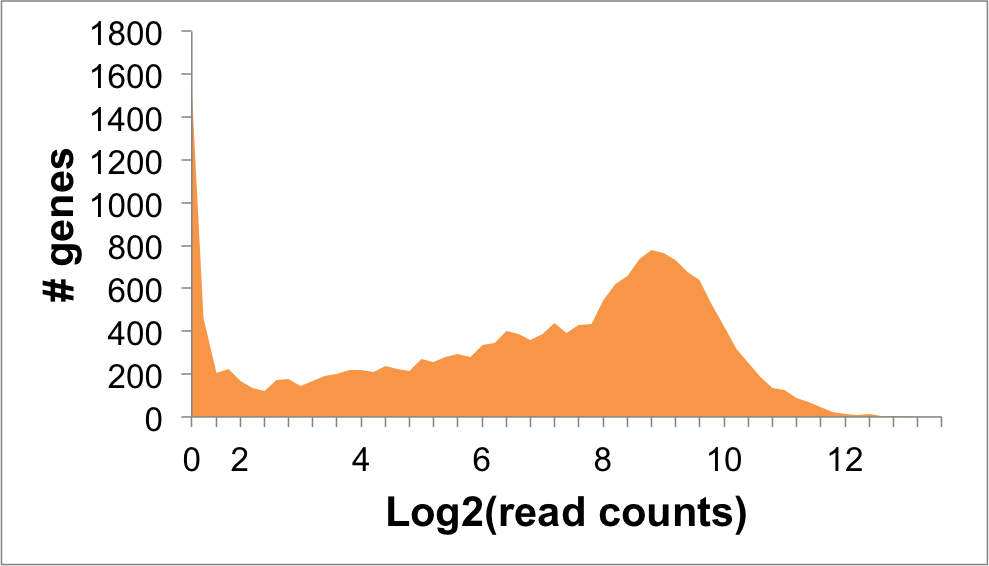
- Expression level (log2 read counts): 7.42
Expression Distribution
YBX3 Expression in NALM6 Cells: 7.42