GPR37
Gene Information
- Official Symbol: GPR37
- Official Name: G protein-coupled receptor 37
- Aliases and Previous Symbols: N/A
- Entrez ID: 2861
- UniProt: O15354
- Interactions: BioGRID
- PubMed articles: Open PubMed
- OMIM: Open OMIM
Function Summary
- Entrez Summary: N/A
- UniProt Summary: Receptor for the neuroprotective and glioprotective factor prosaposin. Ligand binding induces endocytosis, followed by an ERK phosphorylation cascade. {ECO:0000269|PubMed:11439185, ECO:0000269|PubMed:23690594, ECO:0000269|PubMed:9526070}.
Pfam Domains GO Terms
Pfam Domains
| 7tm 1 |
GO Terms
| prosaposin receptor activity |
| locomotion involved in locomotory behavior |
| positive regulation of catecholamine metabolic process |
| positive regulation of dopamine metabolic process |
| positive regulation of cellular amine metabolic process |
| dopamine biosynthetic process |
| negative regulation of hydrogen peroxide-induced cell death |
| negative regulation of response to reactive oxygen species |
| catechol-containing compound biosynthetic process |
| catecholamine biosynthetic process |
| regulation of dopamine metabolic process |
| regulation of catecholamine metabolic process |
| negative regulation of cellular response to drug |
| regulation of hydrogen peroxide-induced cell death |
| negative regulation of response to drug |
| dopamine metabolic process |
| phenol-containing compound biosynthetic process |
| regulation of response to reactive oxygen species |
| regulation of cellular response to drug |
| G protein-coupled peptide receptor activity |
| Hsp70 protein binding |
| catechol-containing compound metabolic process |
| catecholamine metabolic process |
| negative regulation of cellular response to oxidative stress |
| negative regulation of oxidative stress-induced cell death |
| negative regulation of response to oxidative stress |
| peptide binding |
| heat shock protein binding |
| regulation of oxidative stress-induced cell death |
| regulation of cellular response to oxidative stress |
| regulation of cellular amine metabolic process |
| phenol-containing compound metabolic process |
| regulation of response to oxidative stress |
| adenylate cyclase-inhibiting G protein-coupled receptor signaling pathway |
| regulation of response to drug |
| ubiquitin ligase complex |
| organic hydroxy compound biosynthetic process |
| ammonium ion metabolic process |
| locomotory behavior |
| receptor complex |
| adenylate cyclase-modulating G protein-coupled receptor signaling pathway |
| G protein-coupled receptor signaling pathway, coupled to cyclic nucleotide second messenger |
| ubiquitin protein ligase binding |
| organic hydroxy compound metabolic process |
| drug metabolic process |
| positive regulation of MAPK cascade |
| behavior |
| G protein-coupled receptor activity |
| regulation of cellular response to stress |
| regulation of MAPK cascade |
| endoplasmic reticulum membrane |
| negative regulation of cell death |
| endoplasmic reticulum |
| positive regulation of protein phosphorylation |
| positive regulation of intracellular signal transduction |
| positive regulation of phosphorylation |
| positive regulation of phosphorus metabolic process |
| positive regulation of phosphate metabolic process |
| aromatic compound biosynthetic process |
| positive regulation of protein modification process |
| organic cyclic compound biosynthetic process |
| locomotion |
| G protein-coupled receptor signaling pathway |
| integral component of plasma membrane |
| organonitrogen compound biosynthetic process |
| regulation of protein phosphorylation |
| regulation of response to stress |
| regulation of phosphorylation |
| positive regulation of cellular protein metabolic process |
| negative regulation of response to stimulus |
| positive regulation of signal transduction |
| regulation of cell death |
| positive regulation of protein metabolic process |
| regulation of phosphate metabolic process |
| regulation of phosphorus metabolic process |
| positive regulation of cell communication |
| positive regulation of signaling |
| regulation of intracellular signal transduction |
| regulation of protein modification process |
CRISPR Data
Compound Hit Most Correlated Genes in Chemogenomics Tissues where Essential in the Avana Dataset (DepMap 20Q1)
Compound Hit
| Screen | Score |
|---|---|
| Etoposide 0.3μM R05 exp199 | -1.88 |
| SGC2096 2.6μM R03 exp153 | -1.71 |
| Bisphenol S 100μM R08 exp458 | 1.72 |
| CAY10603 0.55μM R08 exp467 | 1.75 |
Most Correlated Genes in Chemogenomics
No correlation found to any other genes in chemogenomics.
Tissues where Essential in the Avana Dataset (DepMap 20Q1)
Global Fraction of Cell Lines Where Essential: 0/739
| Tissue | Fraction Of Cell Lines Where Essential |
|---|---|
| 1290807.0 | 0/1 |
| 909776.0 | 0/1 |
| bile duct | 0/28 |
| blood | 0/28 |
| bone | 0/26 |
| breast | 0/33 |
| central nervous system | 0/56 |
| cervix | 0/4 |
| colorectal | 0/17 |
| esophagus | 0/13 |
| fibroblast | 0/1 |
| gastric | 0/16 |
| kidney | 0/21 |
| liver | 0/20 |
| lung | 0/75 |
| lymphocyte | 0/16 |
| ovary | 0/26 |
| pancreas | 0/24 |
| peripheral nervous system | 0/16 |
| plasma cell | 0/15 |
| prostate | 0/1 |
| skin | 0/24 |
| soft tissue | 0/9 |
| thyroid | 0/2 |
| upper aerodigestive | 0/22 |
| urinary tract | 0/29 |
| uterus | 0/5 |
Essentiality in NALM6
- Essentiality Rank: 8652
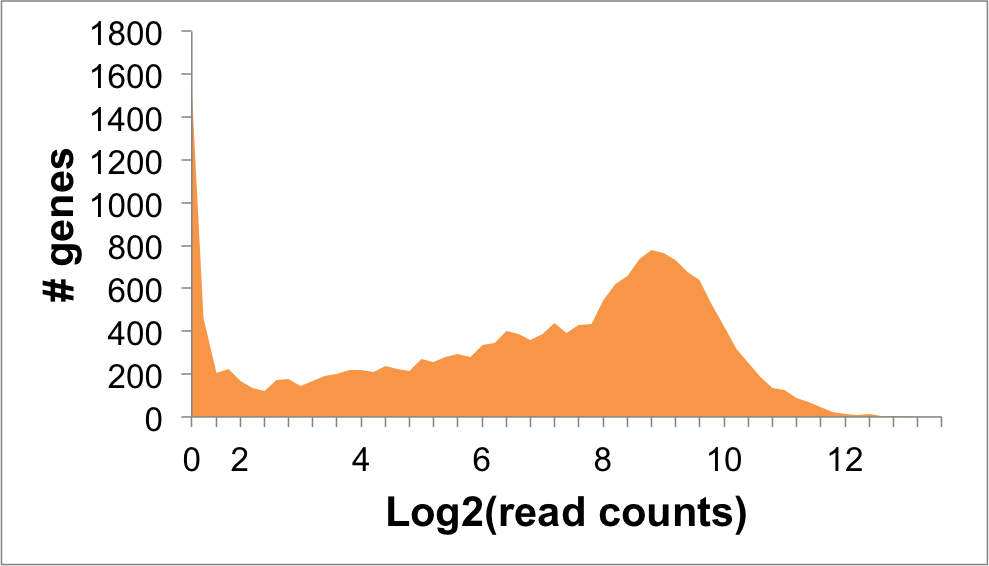
- Expression level (log2 read counts): -7.68
Expression Distribution
GPR37 Expression in NALM6 Cells: -7.68