NR1H2
Gene Information
- Official Symbol: NR1H2
- Official Name: nuclear receptor subfamily 1 group H member 2
- Aliases and Previous Symbols: N/A
- Entrez ID: 7376
- UniProt: P55055
- Interactions: BioGRID
- PubMed articles: Open PubMed
- OMIM: Open OMIM
Function Summary
- Entrez Summary: N/A
- UniProt Summary: Nuclear receptor. Binds preferentially to double- stranded oligonucleotide direct repeats having the consensus half- site sequence 5'-AGGTCA-3' and 4-nt spacing (DR-4). Regulates cholesterol uptake through MYLIP-dependent ubiquitination of LDLR, VLDLR and LRP8; DLDLR and LRP8. Interplays functionally with RORA for the regulation of genes involved in liver metabolism (By similarity). Exhibits a ligand-dependent transcriptional activation activity (PubMed:25661920). {ECO:0000250|UniProtKB:Q60644, ECO:0000269|PubMed:25661920}.
Pfam Domains GO Terms
Pfam Domains
| Hormone recep |
| zf-C4 |
GO Terms
| apolipoprotein A-I receptor binding |
| negative regulation of pinocytosis |
| negative regulation of interferon-gamma-mediated signaling pathway |
| negative regulation of response to interferon-gamma |
| negative regulation of cholesterol storage |
| positive regulation of lipoprotein lipase activity |
| positive regulation of triglyceride lipase activity |
| regulation of pinocytosis |
| positive regulation of triglyceride biosynthetic process |
| negative regulation of macrophage derived foam cell differentiation |
| regulation of cholesterol storage |
| positive regulation of cholesterol efflux |
| regulation of triglyceride biosynthetic process |
| positive regulation of fatty acid biosynthetic process |
| negative regulation of lipid storage |
| positive regulation of triglyceride metabolic process |
| regulation of lipoprotein lipase activity |
| positive regulation of cholesterol transport |
| regulation of cholesterol efflux |
| positive regulation of sterol transport |
| regulation of response to interferon-gamma |
| regulation of interferon-gamma-mediated signaling pathway |
| negative regulation of lipid transport |
| regulation of macrophage derived foam cell differentiation |
| positive regulation of fatty acid metabolic process |
| regulation of triglyceride metabolic process |
| negative regulation of lipid localization |
| negative regulation of endocytosis |
| regulation of fatty acid biosynthetic process |
| regulation of lipid storage |
| regulation of cholesterol transport |
| regulation of sterol transport |
| nuclear receptor activity |
| negative regulation of cold-induced thermogenesis |
| steroid hormone receptor activity |
| negative regulation of innate immune response |
| negative regulation of cytokine-mediated signaling pathway |
| positive regulation of lipid transport |
| negative regulation of response to cytokine stimulus |
| nuclear receptor transcription coactivator activity |
| positive regulation of lipase activity |
| RNA polymerase II transcription factor complex |
| transcription regulatory region sequence-specific DNA binding |
| positive regulation of lipid biosynthetic process |
| cholesterol homeostasis |
| ATPase binding |
| sterol homeostasis |
| positive regulation of lipid localization |
| regulation of fatty acid metabolic process |
| negative regulation of response to biotic stimulus |
| regulation of lipase activity |
| regulation of lipid transport |
| steroid hormone mediated signaling pathway |
| lipid homeostasis |
| regulation of lipid localization |
| positive regulation of small molecule metabolic process |
| positive regulation of lipid metabolic process |
| regulation of cold-induced thermogenesis |
| negative regulation of immune response |
| intracellular receptor signaling pathway |
| regulation of cytokine-mediated signaling pathway |
| hormone-mediated signaling pathway |
| regulation of cellular ketone metabolic process |
| regulation of response to cytokine stimulus |
| transcription initiation from RNA polymerase II promoter |
| cellular response to lipopolysaccharide |
| regulation of lipid biosynthetic process |
| cellular response to steroid hormone stimulus |
| cellular response to molecule of bacterial origin |
| signaling receptor activity |
| regulation of endocytosis |
| negative regulation of defense response |
| negative regulation of multi-organism process |
| cellular response to biotic stimulus |
| DNA-templated transcription, initiation |
| RNA polymerase II regulatory region sequence-specific DNA binding |
| response to lipopolysaccharide |
| response to molecule of bacterial origin |
| response to steroid hormone |
| transcription factor binding |
| negative regulation of response to external stimulus |
| regulation of lipid metabolic process |
| sequence-specific DNA binding |
| regulation of small molecule metabolic process |
| negative regulation of immune system process |
| DNA-binding transcription activator activity, RNA polymerase II-specific |
| regulation of innate immune response |
| transcription by RNA polymerase II |
| negative regulation of transport |
| RNA polymerase II proximal promoter sequence-specific DNA binding |
| cellular response to lipid |
| regulation of response to biotic stimulus |
| cellular response to organic cyclic compound |
| regulation of vesicle-mediated transport |
| cellular response to hormone stimulus |
| transcription, DNA-templated |
| nucleic acid-templated transcription |
| RNA biosynthetic process |
| DNA-binding transcription factor activity |
| response to bacterium |
| negative regulation of cellular component organization |
| negative regulation of cell differentiation |
| regulation of defense response |
| positive regulation of hydrolase activity |
| regulation of multi-organism process |
| zinc ion binding |
| response to lipid |
| negative regulation of transcription by RNA polymerase II |
| response to hormone |
| response to organic cyclic compound |
| negative regulation of developmental process |
| positive regulation of transport |
| cellular response to oxygen-containing compound |
| regulation of response to external stimulus |
| nucleobase-containing compound biosynthetic process |
| chemical homeostasis |
| regulation of immune response |
| heterocycle biosynthetic process |
| aromatic compound biosynthetic process |
| negative regulation of transcription, DNA-templated |
| negative regulation of multicellular organismal process |
| lipid metabolic process |
| positive regulation of transcription by RNA polymerase II |
| cellular response to endogenous stimulus |
| negative regulation of nucleic acid-templated transcription |
| negative regulation of RNA biosynthetic process |
| negative regulation of signal transduction |
| regulation of hydrolase activity |
| response to other organism |
| organic cyclic compound biosynthetic process |
| response to external biotic stimulus |
| response to biotic stimulus |
| negative regulation of RNA metabolic process |
| negative regulation of cell communication |
| negative regulation of signaling |
| negative regulation of cellular macromolecule biosynthetic process |
| positive regulation of catalytic activity |
| negative regulation of nucleobase-containing compound metabolic process |
| DNA binding |
| negative regulation of macromolecule biosynthetic process |
| response to endogenous stimulus |
| regulation of response to stress |
| negative regulation of cellular biosynthetic process |
| positive regulation of transcription, DNA-templated |
| negative regulation of biosynthetic process |
| response to oxygen-containing compound |
| DNA-binding transcription factor activity, RNA polymerase II-specific |
| positive regulation of cellular protein metabolic process |
| negative regulation of response to stimulus |
| cellular nitrogen compound biosynthetic process |
| positive regulation of nucleic acid-templated transcription |
| positive regulation of RNA biosynthetic process |
| homeostatic process |
| regulation of immune system process |
| RNA metabolic process |
| positive regulation of protein metabolic process |
| cellular macromolecule biosynthetic process |
| negative regulation of gene expression |
| positive regulation of RNA metabolic process |
| macromolecule biosynthetic process |
| positive regulation of molecular function |
| regulation of cell differentiation |
| regulation of transport |
| positive regulation of nucleobase-containing compound metabolic process |
| positive regulation of macromolecule biosynthetic process |
| positive regulation of cellular biosynthetic process |
| positive regulation of gene expression |
| gene expression |
| positive regulation of biosynthetic process |
CRISPR Data
Compound Hit Most Correlated Genes in Chemogenomics Tissues where Essential in the Avana Dataset (DepMap 20Q1)
Compound Hit
| Screen | Score |
|---|---|
| Fluvastatin 2.2μM R06 exp282 | -1.96 |
| Cerivastatin 0.15μM R05 exp226 | -1.81 |
| Tubacin 1.6μM R07 exp416 | 2.46 |
| UM0125461 0.74μM R02 exp84 | 2.51 |
Most Correlated Genes in Chemogenomics
| Gene | Correlation |
|---|---|
| ABCG1 | 0.427 |
Tissues where Essential in the Avana Dataset (DepMap 20Q1)
Global Fraction of Cell Lines Where Essential: 0/739
| Tissue | Fraction Of Cell Lines Where Essential |
|---|---|
| 1290807.0 | 0/1 |
| 909776.0 | 0/1 |
| bile duct | 0/28 |
| blood | 0/28 |
| bone | 0/26 |
| breast | 0/33 |
| central nervous system | 0/56 |
| cervix | 0/4 |
| colorectal | 0/17 |
| esophagus | 0/13 |
| fibroblast | 0/1 |
| gastric | 0/16 |
| kidney | 0/21 |
| liver | 0/20 |
| lung | 0/75 |
| lymphocyte | 0/16 |
| ovary | 0/26 |
| pancreas | 0/24 |
| peripheral nervous system | 0/16 |
| plasma cell | 0/15 |
| prostate | 0/1 |
| skin | 0/24 |
| soft tissue | 0/9 |
| thyroid | 0/2 |
| upper aerodigestive | 0/22 |
| urinary tract | 0/29 |
| uterus | 0/5 |
Essentiality in NALM6
- Essentiality Rank: 12973
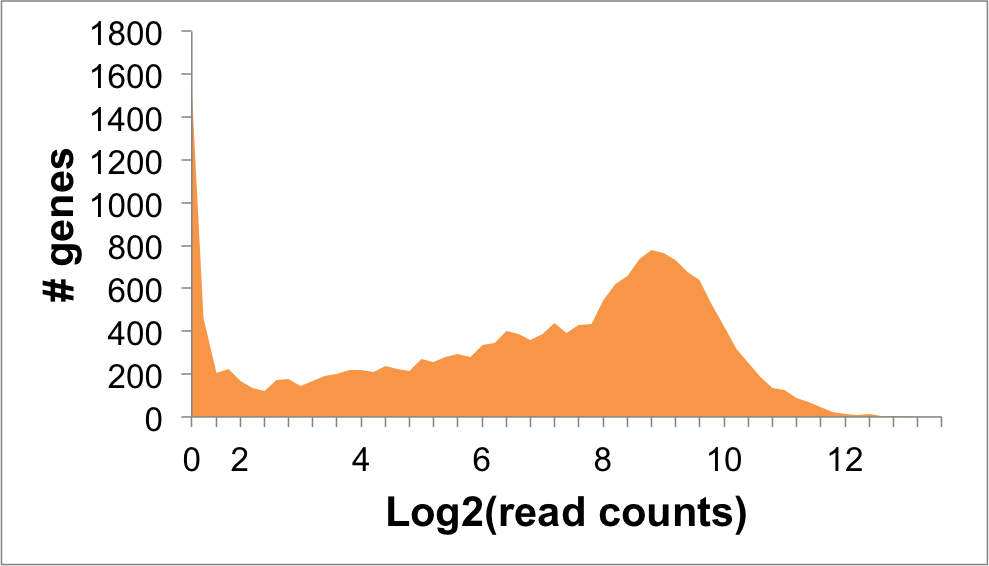
- Expression level (log2 read counts): 4.68
Expression Distribution
NR1H2 Expression in NALM6 Cells: 4.68