ATM
Gene Information
- Official Symbol: ATM
- Official Name: ATM serine/threonine kinase
- Aliases and Previous Symbols: N/A
- Entrez ID: 472
- UniProt: Q13315
- Interactions: BioGRID
- PubMed articles: Open PubMed
- OMIM: Open OMIM
Function Summary
- Entrez Summary: The protein encoded by this gene belongs to the PI3/PI4-kinase family. This protein is an important cell cycle checkpoint kinase that phosphorylates; thus, it functions as a regulator of a wide variety of downstream proteins, including tumor suppressor proteins p53 and BRCA1, checkpoint kinase CHK2, checkpoint proteins RAD17 and RAD9, and DNA repair protein NBS1. This protein and the closely related kinase ATR are thought to be master controllers of cell cycle checkpoint signaling pathways that are required for cell response to DNA damage and for genome stability. Mutations in this gene are associated with ataxia telangiectasia, an autosomal recessive disorder. [provided by RefSeq, Aug 2010].
- UniProt Summary: Serine/threonine protein kinase which activates checkpoint signaling upon double strand breaks (DSBs), apoptosis and genotoxic stresses such as ionizing ultraviolet A light (UVA), thereby acting as a DNA damage sensor. Recognizes the substrate consensus sequence [ST]-Q. Phosphorylates 'Ser-139' of histone variant H2AX/H2AFX at double strand breaks (DSBs), thereby regulating DNA damage response mechanism. Also plays a role in pre-B cell allelic exclusion, a process leading to expression of a single immunoglobulin heavy chain allele to enforce clonality and monospecific recognition by the B-cell antigen receptor (BCR) expressed on individual B-lymphocytes. After the introduction of DNA breaks by the RAG complex on one immunoglobulin allele, acts by mediating a repositioning of the second allele to pericentromeric heterochromatin, preventing accessibility to the RAG complex and recombination of the second allele. Also involved in signal transduction and cell cycle control. May function as a tumor suppressor. Necessary for activation of ABL1 and SAPK. Phosphorylates DYRK2, CHEK2, p53/TP53, FANCD2, NFKBIA, BRCA1, CTIP, nibrin (NBN), TERF1, RAD9 and DCLRE1C. May play a role in vesicle and/or protein transport. Could play a role in T-cell development, gonad and neurological function. Plays a role in replication-dependent histone mRNA degradation. Binds DNA ends. Phosphorylation of DYRK2 in nucleus in response to genotoxic stress prevents its MDM2-mediated ubiquitination and subsequent proteasome degradation. Phosphorylates ATF2 which stimulates its function in DNA damage response. {ECO:0000269|PubMed:10973490, ECO:0000269|PubMed:12556884, ECO:0000269|PubMed:14871926, ECO:0000269|PubMed:15916964, ECO:0000269|PubMed:16086026, ECO:0000269|PubMed:16858402, ECO:0000269|PubMed:17923702, ECO:0000269|PubMed:19965871}.
Pfam Domains GO Terms
Pfam Domains
| FAT |
| FATC |
| PI3 PI4 kinase |
| TAN |
GO Terms
| regulation of cellular response to gamma radiation |
| signal transduction involved in mitotic G2 DNA damage checkpoint |
| establishment of protein-containing complex localization to telomere |
| positive regulation of telomerase catalytic core complex assembly |
| establishment of RNA localization to telomere |
| regulation of telomerase catalytic core complex assembly |
| regulation of response to gamma radiation |
| DNA-dependent protein kinase activity |
| pre-B cell allelic exclusion |
| cellular response to nitrosative stress |
| pre-B cell differentiation |
| DNA repair complex |
| positive regulation of DNA catabolic process |
| establishment of protein localization to telomere |
| positive regulation of histone phosphorylation |
| response to nitrosative stress |
| negative regulation of telomere capping |
| peptidyl-serine autophosphorylation |
| DNA damage induced protein phosphorylation |
| immature B cell differentiation |
| 1-phosphatidylinositol-3-kinase activity |
| cellular response to X-ray |
| meiotic telomere clustering |
| replicative senescence |
| signal transduction involved in G2 DNA damage checkpoint |
| chromosome localization to nuclear envelope involved in homologous chromosome segregation |
| regulation of histone phosphorylation |
| regulation of DNA catabolic process |
| telomere localization |
| phosphatidylinositol-3-phosphate biosynthetic process |
| lipoprotein catabolic process |
| positive regulation of DNA damage response, signal transduction by p53 class mediator |
| protein localization to chromosome, telomeric region |
| establishment of protein localization to chromosome |
| negative regulation of B cell proliferation |
| histone mRNA catabolic process |
| V(D)J recombination |
| regulation of microglial cell activation |
| determination of adult lifespan |
| mitotic G2 DNA damage checkpoint |
| negative regulation of TORC1 signaling |
| DNA double-strand break processing |
| spindle checkpoint |
| mitotic spindle checkpoint |
| spindle assembly checkpoint |
| positive regulation of signal transduction by p53 class mediator |
| mitotic spindle assembly checkpoint |
| negative regulation of mitotic metaphase/anaphase transition |
| negative regulation of metaphase/anaphase transition of cell cycle |
| regulation of telomere capping |
| negative regulation of mitotic sister chromatid separation |
| mitotic G2/M transition checkpoint |
| negative regulation of chromosome separation |
| histone phosphorylation |
| G2 DNA damage checkpoint |
| histone mRNA metabolic process |
| response to X-ray |
| negative regulation of mitotic sister chromatid segregation |
| negative regulation of B cell activation |
| cellular response to gamma radiation |
| regulation of neuroinflammatory response |
| female meiotic nuclear division |
| negative regulation of sister chromatid segregation |
| negative regulation of chromosome segregation |
| regulation of DNA damage response, signal transduction by p53 class mediator |
| positive regulation of telomere maintenance via telomerase |
| multicellular organism aging |
| somatic cell DNA recombination |
| somatic diversification of immune receptors via germline recombination within a single locus |
| negative regulation of telomere maintenance |
| positive regulation of telomere maintenance via telomere lengthening |
| oocyte development |
| regulation of TORC1 signaling |
| negative regulation of mitotic nuclear division |
| oocyte differentiation |
| neuron apoptotic process |
| thymus development |
| negative regulation of nuclear division |
| male meiotic nuclear division |
| negative regulation of TOR signaling |
| somatic diversification of immune receptors |
| chromosome, telomeric region |
| positive regulation of telomere maintenance |
| regulation of telomerase activity |
| ovarian follicle development |
| reciprocal meiotic recombination |
| regulation of mitotic metaphase/anaphase transition |
| neuron death |
| homologous recombination |
| regulation of macrophage activation |
| regulation of metaphase/anaphase transition of cell cycle |
| positive regulation of neuron apoptotic process |
| regulation of telomere maintenance via telomerase |
| response to gamma radiation |
| DNA damage response, signal transduction by p53 class mediator resulting in cell cycle arrest |
| regulation of mitotic sister chromatid separation |
| signal transduction involved in mitotic DNA damage checkpoint |
| signal transduction involved in mitotic cell cycle checkpoint |
| homologous chromosome segregation |
| signal transduction involved in mitotic G1 DNA damage checkpoint |
| intracellular signal transduction involved in G1 DNA damage checkpoint |
| signal transduction involved in mitotic DNA integrity checkpoint |
| double-strand break repair via nonhomologous end joining |
| regulation of telomere maintenance via telomere lengthening |
| regulation of B cell proliferation |
| regulation of chromosome separation |
| protein localization to chromosome |
| mitotic G1 DNA damage checkpoint |
| mitotic G1/S transition checkpoint |
| cell aging |
| non-recombinational repair |
| G1 DNA damage checkpoint |
| chromosome organization involved in meiotic cell cycle |
| somitogenesis |
| positive regulation of DNA biosynthetic process |
| regulation of mitotic sister chromatid segregation |
| cellular response to ionizing radiation |
| cellular response to retinoic acid |
| intrinsic apoptotic signaling pathway in response to DNA damage |
| signal transduction involved in DNA integrity checkpoint |
| signal transduction involved in DNA damage checkpoint |
| signal transduction involved in cell cycle checkpoint |
| establishment of chromosome localization |
| negative regulation of mononuclear cell proliferation |
| negative regulation of lymphocyte proliferation |
| chromosome localization |
| oogenesis |
| negative regulation of leukocyte proliferation |
| DNA damage response, signal transduction by p53 class mediator |
| regulation of cellular response to heat |
| positive regulation of cell cycle arrest |
| regulation of sister chromatid segregation |
| multicellular organism growth |
| somite development |
| regulation of telomere maintenance |
| female gonad development |
| negative regulation of G2/M transition of mitotic cell cycle |
| meiotic chromosome segregation |
| post-embryonic development |
| positive regulation of histone modification |
| positive regulation of neuron death |
| development of primary female sexual characteristics |
| mitotic DNA damage checkpoint |
| segmentation |
| double-strand break repair via homologous recombination |
| recombinational repair |
| telomere maintenance |
| positive regulation of response to DNA damage stimulus |
| negative regulation of cell cycle G2/M phase transition |
| telomere organization |
| regulation of TOR signaling |
| negative regulation of G1/S transition of mitotic cell cycle |
| regulation of chromosome segregation |
| positive regulation of chromatin organization |
| mitotic DNA integrity checkpoint |
| signal transduction in response to DNA damage |
| negative regulation of cell cycle G1/S phase transition |
| female sex differentiation |
| protein N-terminus binding |
| regulation of cell cycle arrest |
| B cell differentiation |
| response to retinoic acid |
| phosphatidylinositol biosynthetic process |
| nuclear chromosome, telomeric region |
| meiosis I |
| meiosis I cell cycle process |
| regulation of DNA biosynthetic process |
| lipoprotein metabolic process |
| spindle |
| signal transduction by p53 class mediator |
| negative regulation of DNA metabolic process |
| female gamete generation |
| DNA damage checkpoint |
| negative regulation of chromosome organization |
| DNA integrity checkpoint |
| negative regulation of lymphocyte activation |
| regulation of histone modification |
| cell cycle arrest |
| intrinsic apoptotic signaling pathway |
| response to ionizing radiation |
| regulation of G1/S transition of mitotic cell cycle |
| meiotic nuclear division |
| mitotic cell cycle checkpoint |
| B cell activation |
| immunoglobulin production |
| protein dimerization activity |
| meiotic cell cycle process |
| regulation of cell cycle G1/S phase transition |
| regulation of mitotic nuclear division |
| phosphatidylinositol metabolic process |
| negative regulation of leukocyte activation |
| cellular response to radiation |
| positive regulation of chromosome organization |
| peptidyl-serine phosphorylation |
| production of molecular mediator of immune response |
| regulation of signal transduction by p53 class mediator |
| double-strand break repair |
| regulation of chromatin organization |
| regulation of nuclear division |
| cell cycle checkpoint |
| protein autophosphorylation |
| positive regulation of DNA metabolic process |
| establishment of RNA localization |
| regulation of G2/M transition of mitotic cell cycle |
| negative regulation of cell activation |
| nuclear-transcribed mRNA catabolic process |
| peptidyl-serine modification |
| glycerophospholipid biosynthetic process |
| regulation of neuron apoptotic process |
| regulation of B cell activation |
| regulation of lymphocyte proliferation |
| cellular response to acid chemical |
| gonad development |
| regulation of mononuclear cell proliferation |
| regulation of cell cycle G2/M phase transition |
| negative regulation of mitotic cell cycle phase transition |
| DNA replication |
| RNA localization |
| development of primary sexual characteristics |
| mRNA catabolic process |
| anterior/posterior pattern specification |
| regulation of response to DNA damage stimulus |
| nuclear chromosome segregation |
| glycerolipid biosynthetic process |
| regulation of leukocyte proliferation |
| DNA recombination |
| meiotic cell cycle |
| negative regulation of cell cycle phase transition |
| lymphocyte differentiation |
| phospholipid biosynthetic process |
| RNA catabolic process |
| positive regulation of protein complex assembly |
| cytoplasmic vesicle |
| protein-containing complex localization |
| germ cell development |
| sex differentiation |
| protein-containing complex binding |
| chromosome segregation |
| aging |
| apoptotic signaling pathway |
| nuclear division |
| positive regulation of cell cycle process |
| negative regulation of mitotic cell cycle |
| glycerophospholipid metabolic process |
| regulation of neuron death |
| organelle fission |
| cellular response to abiotic stimulus |
| cellular response to environmental stimulus |
| negative regulation of cell cycle process |
| leukocyte differentiation |
| regulation of autophagy |
| regionalization |
| regulation of inflammatory response |
| anatomical structure homeostasis |
| response to hypoxia |
| response to acid chemical |
| regulation of chromosome organization |
| cellular process involved in reproduction in multicellular organism |
| regulation of DNA metabolic process |
| response to decreased oxygen levels |
| establishment of organelle localization |
| protein serine/threonine kinase activity |
| histone modification |
| positive regulation of cellular catabolic process |
| negative regulation of organelle organization |
| nucleobase-containing compound catabolic process |
| covalent chromatin modification |
| phospholipid metabolic process |
| positive regulation of cell cycle |
| glycerolipid metabolic process |
| response to oxygen levels |
| lymphocyte activation |
| developmental growth |
| growth |
| positive regulation of cell adhesion |
| gland development |
| regulation of mitotic cell cycle phase transition |
| reproductive structure development |
| reproductive system development |
| positive regulation of catabolic process |
| establishment of protein localization to organelle |
| heterocycle catabolic process |
| cellular nitrogen compound catabolic process |
| pattern specification process |
| response to radiation |
| negative regulation of immune system process |
| aromatic compound catabolic process |
| regulation of cell cycle phase transition |
| regulation of protein complex assembly |
| organic cyclic compound catabolic process |
| positive regulation of cell migration |
| negative regulation of intracellular signal transduction |
| DNA repair |
| regulation of lymphocyte activation |
| cellular response to lipid |
| positive regulation of cellular component biogenesis |
| positive regulation of cell motility |
| heart development |
| organophosphate biosynthetic process |
| positive regulation of cellular component movement |
| positive regulation of locomotion |
| hemopoiesis |
| male gamete generation |
| negative regulation of cell cycle |
| lipid biosynthetic process |
| organelle localization |
| mitotic cell cycle process |
| regulation of leukocyte activation |
| hematopoietic or lymphoid organ development |
| positive regulation of organelle organization |
| regulation of mitotic cell cycle |
| chordate embryonic development |
| regulation of cell activation |
| positive regulation of apoptotic process |
| immune system development |
| positive regulation of programmed cell death |
| embryo development ending in birth or egg hatching |
| developmental process involved in reproduction |
| negative regulation of cell population proliferation |
| regulation of cell adhesion |
| protein catabolic process |
| mitotic cell cycle |
| gamete generation |
| mRNA metabolic process |
| positive regulation of cell death |
| chromatin organization |
| negative regulation of cellular component organization |
| protein localization to organelle |
| regulation of cellular response to stress |
| brain development |
| DNA metabolic process |
| regulation of cell cycle process |
| regulation of defense response |
| cellular response to DNA damage stimulus |
| head development |
| multicellular organismal reproductive process |
| sexual reproduction |
| regulation of cellular catabolic process |
| multicellular organism reproduction |
| regulation of cell migration |
| response to lipid |
| nucleolus |
| circulatory system development |
| peptidyl-amino acid modification |
| organophosphate metabolic process |
| anatomical structure formation involved in morphogenesis |
| cellular macromolecule catabolic process |
| regulation of cell motility |
| apoptotic process |
| leukocyte activation |
| cellular lipid metabolic process |
| regulation of cellular component biogenesis |
| protein phosphorylation |
| regulation of transferase activity |
| embryo development |
| central nervous system development |
| regulation of locomotion |
| regulation of cellular component movement |
| regulation of catabolic process |
| multi-organism reproductive process |
| cell cycle process |
| positive regulation of protein phosphorylation |
| positive regulation of intracellular signal transduction |
| macromolecule catabolic process |
| programmed cell death |
| cellular response to oxygen-containing compound |
| positive regulation of phosphorylation |
| organonitrogen compound catabolic process |
| chromosome organization |
| cell activation |
| cell death |
| regulation of response to external stimulus |
| epithelium development |
| positive regulation of phosphate metabolic process |
| positive regulation of phosphorus metabolic process |
| response to abiotic stimulus |
| regulation of cell cycle |
| positive regulation of cellular component organization |
| lipid metabolic process |
| positive regulation of transcription by RNA polymerase II |
| positive regulation of protein modification process |
| negative regulation of signal transduction |
| phosphorylation |
| regulation of organelle organization |
| cell cycle |
| negative regulation of cell communication |
| negative regulation of signaling |
| reproductive process |
| reproduction |
| negative regulation of nucleobase-containing compound metabolic process |
| regulation of protein phosphorylation |
| DNA binding |
| regulation of response to stress |
| ATP binding |
| regulation of apoptotic process |
| positive regulation of transcription, DNA-templated |
| response to oxygen-containing compound |
| regulation of programmed cell death |
| cellular protein localization |
| regulation of phosphorylation |
| cellular macromolecule localization |
| positive regulation of cellular protein metabolic process |
| establishment of protein localization |
| regulation of cell population proliferation |
| negative regulation of response to stimulus |
| positive regulation of nucleic acid-templated transcription |
| positive regulation of RNA biosynthetic process |
| homeostatic process |
| cell development |
| positive regulation of signal transduction |
| regulation of immune system process |
| RNA metabolic process |
| regulation of cell death |
| intracellular signal transduction |
| cellular response to stress |
| positive regulation of protein metabolic process |
| cellular macromolecule biosynthetic process |
| negative regulation of gene expression |
| positive regulation of RNA metabolic process |
| tissue development |
| macromolecule biosynthetic process |
| organic substance catabolic process |
| regulation of phosphate metabolic process |
| regulation of phosphorus metabolic process |
| cellular catabolic process |
| positive regulation of cell communication |
| positive regulation of signaling |
| regulation of intracellular signal transduction |
| establishment of localization in cell |
| regulation of protein modification process |
| positive regulation of nucleobase-containing compound metabolic process |
| positive regulation of macromolecule biosynthetic process |
| positive regulation of cellular biosynthetic process |
| positive regulation of gene expression |
| positive regulation of biosynthetic process |
CRISPR Data
Compound Hit Most Correlated Genes in Chemogenomics Tissues where Essential in the Avana Dataset (DepMap 20Q1)
Compound Hit
| Screen | Score |
|---|---|
| Campthothecin 0.001μM R06 exp270 | -3.09 |
| Etoposide 0.1μM R05 exp198 | -3.01 |
| Genistein 15μM R07 exp360 | -2.69 |
| Rucaparib 6.5μM R08 exp520 | -2.19 |
| Temozolomide 200μM R04 exp189 | -2.11 |
| Talazoparib 0.006μM R06 exp299 | -1.91 |
| A-395N 10μM R05 exp219 | -1.79 |
| PFI-2 4μM R05 exp239 | -1.79 |
| Curcumin 6.5μM R06 exp277 | -1.75 |
| Ribavirin 10μM R01 exp52 | -1.71 |
| Brefeldin A 0.02μM R00 exp8 | 2.02 |
| Etoposide 0.3μM R05 exp199 | 2.52 |
| Actinomycin-D 0.001μM R00 exp3 | 2.57 |
Tissues where Essential in the Avana Dataset (DepMap 20Q1)
Global Fraction of Cell Lines Where Essential: 0/739
| Tissue | Fraction Of Cell Lines Where Essential |
|---|---|
| 1290807.0 | 0/1 |
| 909776.0 | 0/1 |
| bile duct | 0/28 |
| blood | 0/28 |
| bone | 0/26 |
| breast | 0/33 |
| central nervous system | 0/56 |
| cervix | 0/4 |
| colorectal | 0/17 |
| esophagus | 0/13 |
| fibroblast | 0/1 |
| gastric | 0/16 |
| kidney | 0/21 |
| liver | 0/20 |
| lung | 0/75 |
| lymphocyte | 0/16 |
| ovary | 0/26 |
| pancreas | 0/24 |
| peripheral nervous system | 0/16 |
| plasma cell | 0/15 |
| prostate | 0/1 |
| skin | 0/24 |
| soft tissue | 0/9 |
| thyroid | 0/2 |
| upper aerodigestive | 0/22 |
| urinary tract | 0/29 |
| uterus | 0/5 |
Essentiality in NALM6
- Essentiality Rank: 16665
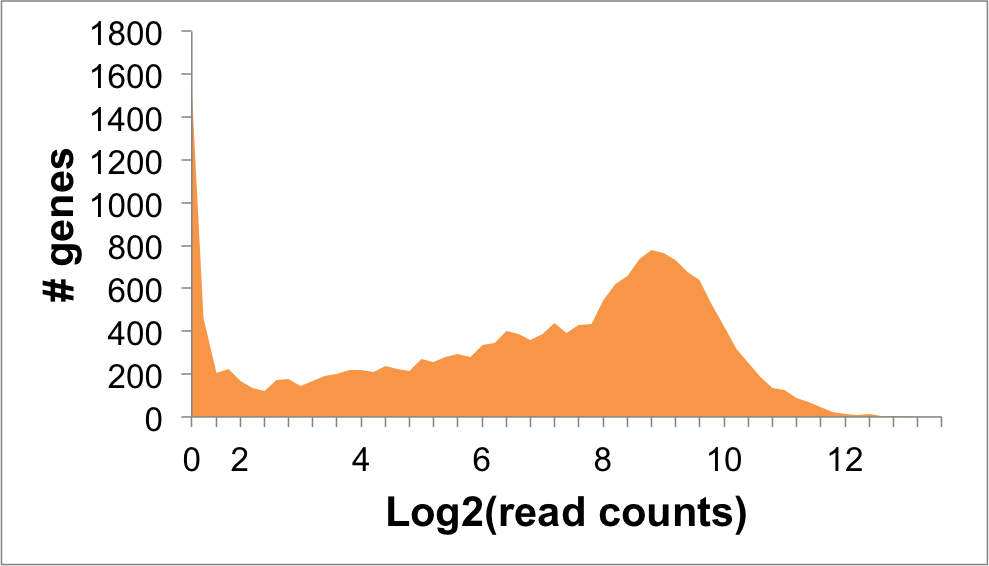
- Expression level (log2 read counts): 7.68
Expression Distribution
ATM Expression in NALM6 Cells: 7.68